
Why Gamified Soccer Training Is the Future of Player Development
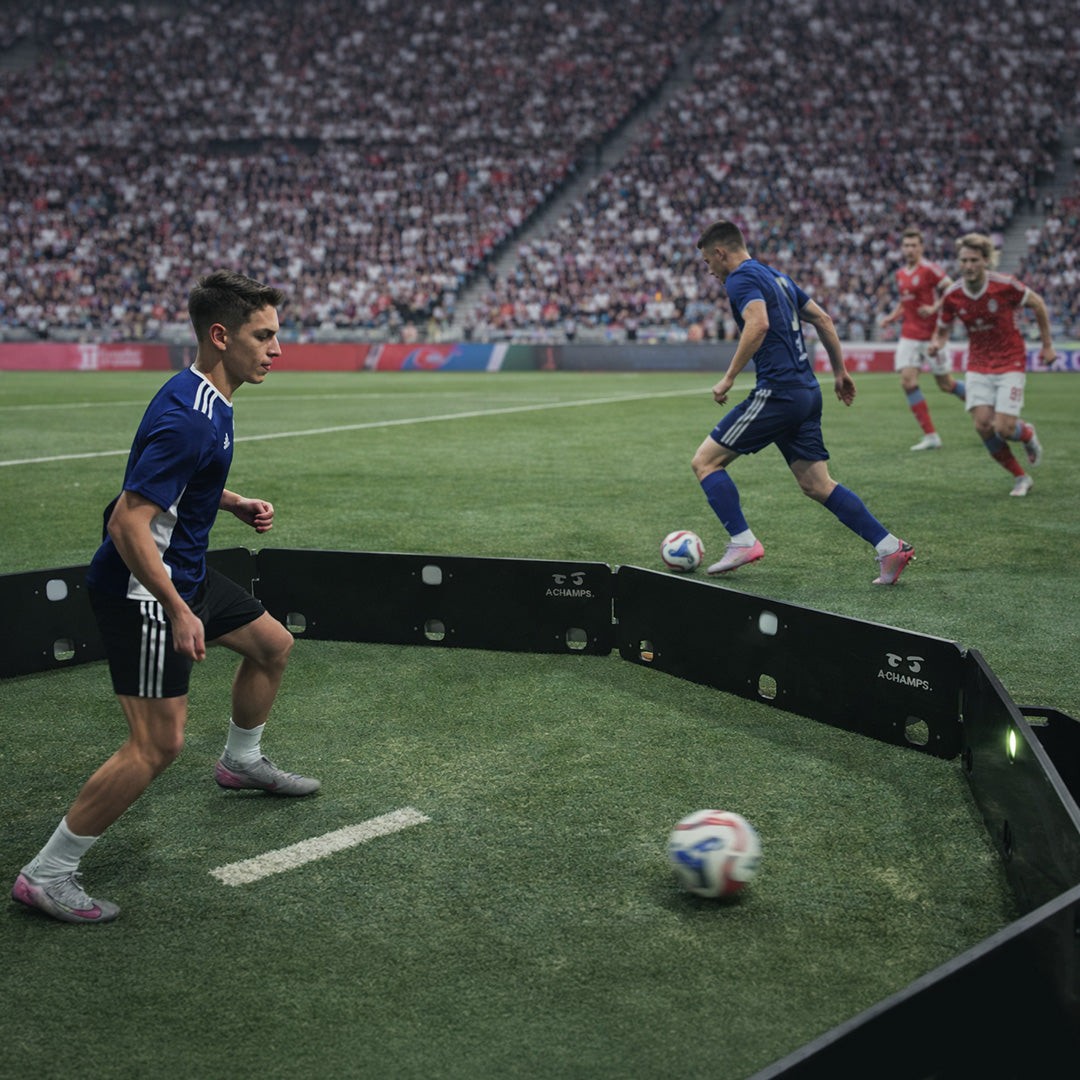
Why Gamified Soccer Training Is the Future of Player Development
Soccer is evolving. The demands on players are higher than ever, and the way athletes train is changing to keep up. One of the biggest shifts happening right now? Gamification — and the data backs it up.
A qualitative study conducted by Kenneth Cortsen, a leading expert in sports technology and data-driven training, examined how gamified training platforms are transforming soccer development at all levels. The findings are hard to ignore.
What Is Gamified Soccer Training?
Gamification, put simply, is the practice of making activities more like games to make them more interesting and enjoyable. In soccer, that means using technology, data, and interactive equipment to turn repetitive technical drills into something players actually want to do.
Goal Station by a-champs has built its entire training philosophy around this idea. Using reaction lights, Rebounders (also called Ignite Trainers), and a smart performance app, Goal Station creates a training environment that is fun, competitive, and directly relevant to match situations — all at the same time.
The Science Behind It
Cortsen's study, which involved players and coaches across various levels of Danish soccer, found that the gamified elements of Goal Station's Methodology drive a level of engagement that traditional training simply can't replicate.
During his research, Cortsen overheard a player say to a teammate: "I got 23, what did you get?" That moment captures everything. Players weren't just going through the motions — they were competing, comparing, and pushing each other to improve. That kind of intrinsic motivation is exactly what coaches spend years trying to cultivate.
One player in the study put it this way: "It is different and fun, and it is a great supplement to the ordinary team training. It gives you some technical skills where you intensively get the opportunity to work with first touches and passes, and there are many opportunities to work with both legs."
The player's assistant coach added that in today's world, where young people are constantly bombarded with stimulation, keeping training engaging is critical. Without the lights and data, the same drill would become boring within minutes. With them, it captures the attention of kids and adults alike.

More Touches. More Reps. Better Players.
Here's a number that puts things into perspective. Research from a UEFA Pro License study found that a player typically completes 150 to 250 soccer actions in a standard training session. A player using Goal Station equipment? Between 800 and 1,100 actions per session.
That's not a small difference. That's a fundamental shift in how much quality work a player gets through in the same amount of time.
And the quality matters just as much as the quantity. The same UEFA research found that 76% of all actions in a soccer match come down to three things: first touch, first pass, and short passes. Goal Station's system is specifically designed to train exactly those skills — under pressure, with constant cognitive engagement, in a way that mirrors what actually happens on the pitch.
The reaction lights are key to this. Rather than passing to a static target, players must read the lights, decide where to play next, and execute — all in a fraction of a second. It's the closest thing to match pressure you can create outside of an actual game.
Building Soccer Intelligence, Not Just Technique
One of the most compelling insights from Cortsen's study is that Goal Station doesn't just improve technical skills in isolation. It builds soccer intelligence — the ability to read the game, anticipate movement, and make better decisions faster.
A coach in the study observed that when players work in pairs using the system, something interesting happens. One player starts to predict where the ball will go based on the patterns of the drill, and both players begin relating to the game more holistically: "There is something verbal but also something about relating to the ball and the game and where the ball may go."
A professional U19 coach and former professional player in England reinforced this point, noting that Goal Station allows coaches to create truly situation-specific training. Rather than generic ball work, players can practice the exact actions their position demands — the right touches, the right passes, the right movements, in the right contexts.
Why This Matters for Every Level of the Game
What makes Goal Station's approach genuinely exciting is that it works across the board. Whether you're a youth player taking your first steps in the game, a semi-professional looking to sharpen your technical edge, or an elite academy trying to produce the next generation of professionals — the platform scales to meet you.
Cortsen's conclusion is clear: there is significant growth potential in gamified soccer training, and that potential is only increasing as technology and data become more central to how the sport develops players. The gamification element taps into deliberate play and intrinsic motivation — two things that are at the heart of why players fall in love with soccer in the first place.

The Bottom Line
The best training isn't always the hardest training. It's the training that players show up for consistently, push themselves through, and actually enjoy. Goal Station has cracked that code — and the research proves it.
More touches. More engagement. More improvement. That's what gamified soccer training delivers.
A huge thank you to Kenneth Cortsen for conducting this study and sharing his insights. For those interested in reading the full research, it can be found in Chapter 9 of "Interactive Sports Technologies: Performance, Participation, Safety" (Routledge Research in Sports Technology and Engineering).